
What does Rw mean?
Rw, the weighted sound reduction index, is a single-number rating of how much airborne sound a building element blocks. It is measured in a laboratory to BS EN ISO 10140, where the partition is built into a test opening between two isolated rooms, and the result is weighted to BS EN ISO 717-1 to reflect how people hear speech and everyday noise. Because the test rooms are isolated, the only path for sound is through the sample itself.
Every increase of around 10 dB is perceived as roughly halving loudness, so a 45 dB partition sounds much quieter than a 35 dB one. Adjustment terms such as C and Ctr are sometimes quoted alongside Rw, for example Rw 45 (-2; -6). They correct the rating for different noise spectra, with Ctr giving more weight to low-frequency sound such as music and traffic.
What Rw do different partition systems achieve?
The table below shows indicative laboratory Rw figures for common systems. Exact values depend on the manufacturer's tested build, glass make-up, cavity width, insulation and seals, so always ask for the test report for the specific system. These figures relate to the partition alone. Doors, ceiling voids and junctions usually reduce real performance, so plan a margin above the rating you need on site.
| System | Indicative lab Rw | Speech privacy, roughly |
|---|---|---|
| 10mm toughened single glazed | 32–35 dB | Normal speech understood |
| 12.8mm acoustic laminated single glazed | 38–40 dB | Normal speech heard, partly understood |
| Double glazed system | 42–52 dB | Normal speech faint to inaudible |
| Single-layer metal stud with insulation | 40–45 dB | Normal speech faint |
| Double-layer acoustic stud | 50–58 dB | Raised voices faint, normal speech inaudible |
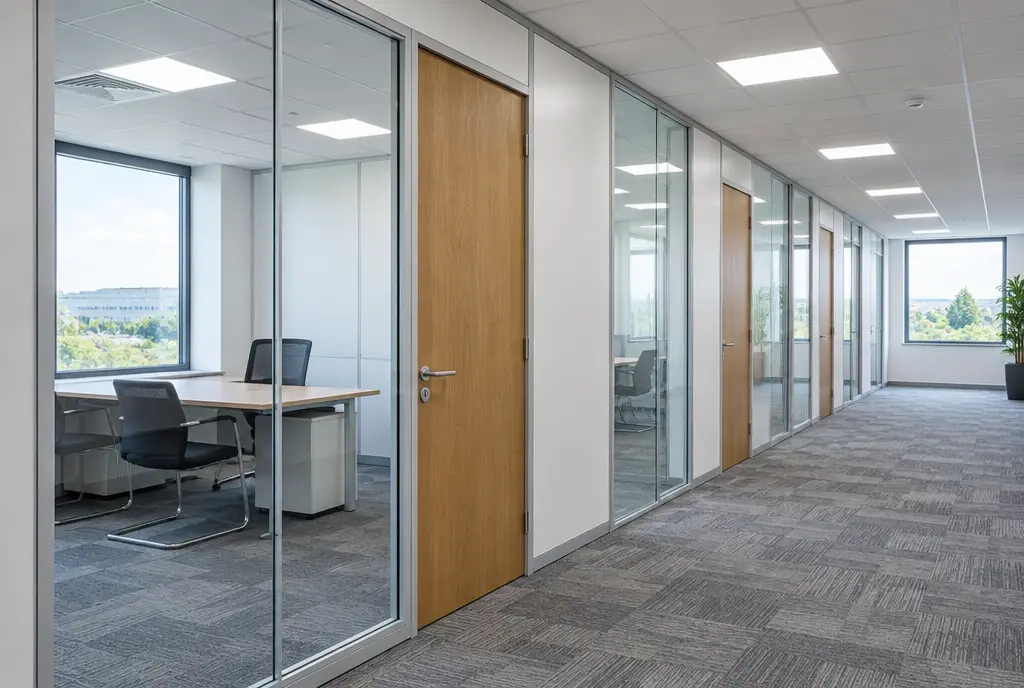
Why is site performance lower than the lab figure?
On site, sound finds routes around the partition as well as through it. This indirect transmission is called flanking. The most common path in offices is over the top of the partition through the ceiling void, because many partitions stop at a suspended ceiling with an open plenum above. Sound also travels through raised access floors, along continuous window mullions, through trunking and ductwork and through gaps around doors. Even a small gap can reduce performance noticeably.
For these reasons site performance is typically several decibels below the laboratory Rw. Site results are measured as DnT,w, the weighted standardised level difference, which describes the real separation between two rooms including all flanking paths. If you need a specified site figure, it must be designed for and measured on site, and the specification should be agreed with an acoustician.
How do you stop sound going over the partition?
Treat the whole room as the acoustic envelope. Where partitions stop at the suspended ceiling, fit a ceiling void barrier above the partition line, usually dense mineral wool or plasterboard extending to the slab, sealed around services. Alternatively take the partition through the ceiling to the soffit. Seal the head, floor and wall junctions with acoustic sealant, and choose a door with drop seals and perimeter seals, because a standard door is often the weakest element in the room.
- Ceiling void barrier above the partition line
- Acoustic seals at head, floor and wall junctions
- Doors with perimeter seals and an automatic drop seal
- Acoustic treatment to ductwork that crosses between rooms
- Window mullion closers where partitions meet external glazing
- Raised floor barriers where the floor void is continuous
What Rw do you need for speech privacy?
The right figure depends on how confidential conversations are and how loud the adjacent area is. Background noise masks speech, so a room next to a busy open-plan area can achieve reasonable privacy with a lower rating than a room next to a quiet corridor. As a rough guide, general meeting rooms are often specified around 40–45 dB Rw for the partition, while confidential rooms such as HR, legal and boardrooms are often specified at 45–50 dB or more, with matching doors and ceiling treatment.
Where privacy is critical, involve an acoustic consultant to set a site target, measured as DnT,w, and to review the junction and door details before ordering. Guide prices for acoustic glass partitions are £550–£850 per m² and for acoustic stud walls £80–£130 per m², supply and install, excluding VAT, confirmed after a free site survey.
Can acoustic performance be improved later?
Often, yes. Many existing meeting rooms perform poorly because of a single weak link rather than the glass. Fitting a ceiling void barrier, adding drop seals to doors, resealing perimeter joints and treating noisy ductwork can make a noticeable difference without replacing the partition. Sound masking systems in open-plan areas can also improve perceived privacy. Where the partition itself is the limiting factor, upgrading single glazing to an acoustic laminate or double glazed system is the next step.
Frequently asked questions
What is a good Rw rating for an office meeting room?
For a general meeting room, a partition rating of around 40–45 dB Rw is a common starting point. For confidential meetings, 45–50 dB or more is typical, combined with a sealed door and ceiling void barrier. Site performance is usually several decibels below the laboratory rating because of flanking.
What is the difference between Rw and DnT,w?
Rw is a laboratory rating of the partition alone, measured with no flanking paths. DnT,w is measured on site between two real rooms and includes all paths, such as the ceiling void, floor, doors and mullions. DnT,w is the figure that describes what occupants actually experience.
Is acoustic laminated glass worth the extra cost?
Often, yes, for single glazed rooms that need more privacy. A 12.8mm acoustic laminated pane typically achieves around 38–40 dB Rw in the lab compared with 32–35 dB for 10mm toughened. It also holds together if broken. For higher privacy, double glazing usually performs better.
Why can I still hear people through my glass meeting room?
Usually because sound is bypassing the glass. Common causes are an open ceiling void above the partition, an unsealed door, gaps at junctions and shared ductwork. A survey can identify the weak links. Ceiling barriers and door seals are often more effective than replacing the glass.
Guide prices are supply and install, excluding VAT, and are confirmed by a fixed quote after a free site survey. Regulatory information is general guidance; your Building Control body, landlord or fire engineer has the final say on a specific project.