
How much do switchable smart glass partitions cost?
Price depends on the switchable glass area, the number of individually controlled zones, the control method and the electrical work needed to bring power and cabling to each panel. Typical lead time: 4–6 weeks. Guide prices, supply and install — fixed after a free survey.
Why choose switchable smart glass partitions?
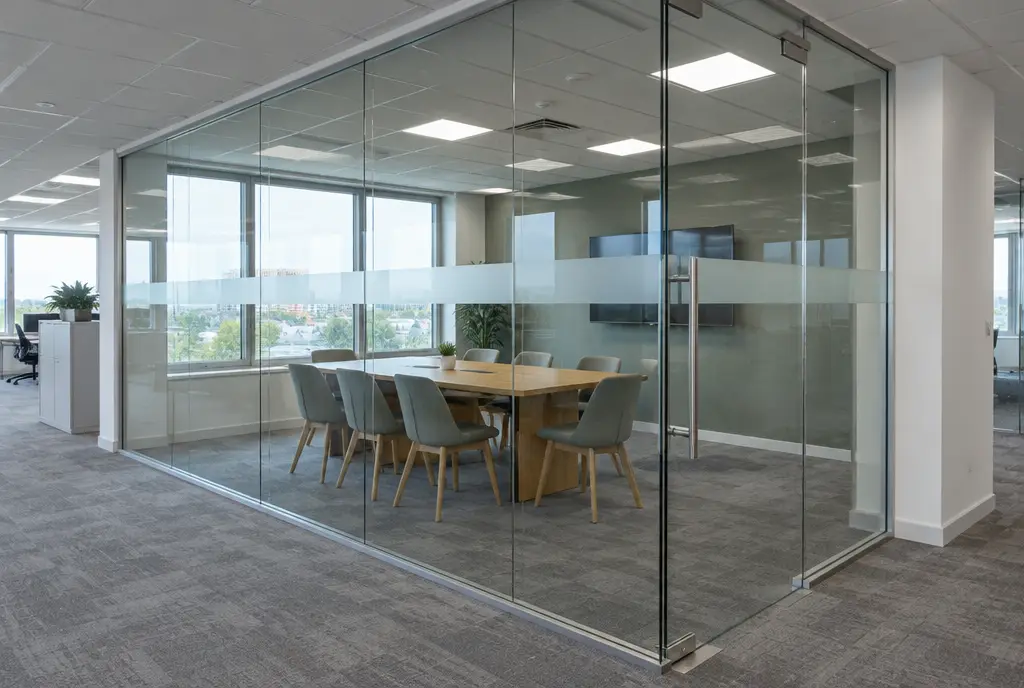
Smart glass solves a common conflict in office design: people want meeting rooms to feel open, but they also need privacy for interviews, screen presentations and sensitive calls. With switchable glass, the wall stays clear by default and turns opaque at the press of a wall switch, a room booking panel or an occupancy sensor. The opaque state still lets diffused light through, so the room never goes dark, and when it switches back the glass is as clear as a standard laminated panel.
It is worth being clear about what smart glass does not do. It gives visual privacy, not acoustic privacy; the sound reduction is that of the laminated glass itself, roughly in line with other single glazed laminate. It also needs a power supply and cabling hidden in the head or base track, so an electrician is involved, and the control method should be agreed early. Many clients put smart glass on the main elevation of a board room and use standard glass with film elsewhere to control cost.
Privacy in seconds
Rooms switch from clear to opaque instantly, so interviews, screen sharing and confidential meetings can happen without drawing blinds or applying permanent film.
Open by default
When privacy is not needed the glass is clear, so meeting rooms keep the open, connected feel that many organisations want across the floor.
No blinds to maintain
There are no slats, cords or fabric to clean, repair or replace, and the clean glass line stays uncluttered whichever state the room is in.
Controls to suit the room
Switching can be linked to occupancy sensors, booking systems or a simple wall switch, so the room behaves the way your team actually uses it.
What are the specifications?
| Technology | PDLC liquid crystal film laminated between two glass layers |
|---|---|
| States | Clear when powered; diffused opaque white when unpowered |
| Glass build-up | Typically 10.8–13.5mm laminated to BS EN 14449 |
| Power | Low-voltage AC via transformer; low running consumption per m² |
| Controls | Wall switch, remote, occupancy sensor or building management system integration |
| Acoustic performance | Approx. Rw 34–38 dB single glazed (lab), similar to standard laminate |
| Framing | Frameless track or framed systems with cabling concealed in head or base |
| Projection | Opaque state can act as a rear-projection screen with suitable projectors |
Where are switchable smart glass partitions used?
- Board and executive rooms
- Interview and HR rooms
- Medical and treatment rooms
- Presentation suites
- Reception privacy screens
- Directors' offices
What regulations and practical points apply?
Smart glass needs a dedicated electrical supply, so allow for an electrician to install and test circuits in line with BS 7671, and agree where transformers will sit. It provides visual privacy only; if conversations must not be overheard, combine it with acoustic glass, sealed doors and attention to flanking. Because the opaque state is translucent, manifestation is still required under Approved Document K for when the glass is clear. Panels cannot be cut on site, so dimensions must be final before ordering. In leased offices, electrical work and any new controls usually fall under the licence for alterations.
How is it installed?
We coordinate power routes with your electrician before ordering, since the cable exit point is fixed in each panel. On site, tracks are installed and cabling is drawn through the head or base, panels are set and connected to the transformer, and the control switch or sensor is wired and tested. Joints are sealed and manifestation applied. A smart glass meeting room front typically takes two to three days, plus electrical testing and a short handover on how the controls work.
Free survey
We visit, measure up, check ceilings, floors and services, and talk through how the space needs to work.
Design and fixed price
You receive a layout, specification and a fixed, itemised quote. Nothing is ordered until you approve the drawings.
Manufacture and planning
Glass and components are made to the surveyed sizes while we plan access, deliveries and any out-of-hours working.
Installation and handover
The team installs, snags and cleans, then hands over with test evidence and care guidance.
Switchable Smart Glass Partitions FAQs
How much does switchable smart glass cost for office partitions?
Switchable smart glass partitions typically cost £1,100–£1,700 per m² supplied and installed, excluding VAT. The glass area, the number of separately switched zones, the control method and the electrical work all affect the price. Many clients use it on one elevation only to control cost. We confirm a fixed price after a free survey.
How does switchable smart glass work?
Smart glass contains a liquid crystal film between two layers of glass. When power is applied, the crystals align and the glass is clear. When power is off, they scatter light and the glass turns opaque white. The change takes seconds and is controlled by a switch, sensor or building system.
Does smart glass make a room soundproof?
No. Switchable glass changes how the room looks, not how much sound passes through. Its acoustic performance is similar to other single glazed laminated glass, roughly Rw 34–38 dB in lab tests. For confidential rooms, combine smart glass with acoustic seals, sealed doors and attention to the ceiling void.
Does smart glass use a lot of electricity?
No. Running consumption is low per square metre, and the glass only draws power while it is clear. A typical meeting room uses a small fraction of the energy of its lighting. The main electrical cost is the one-off installation of the supply and controls.
What happens to smart glass if the power fails?
Most PDLC smart glass turns opaque when power is lost, because it needs power to stay clear. The room keeps its privacy and still receives diffused light. The glass remains safe laminated glass in either state, and it returns to clear automatically when power is restored.