
How much do double glazed partitions cost?
The cavity width, whether one or both panes are acoustic laminate, integral blinds and the specification of acoustically sealed doors account for most of the variation. Typical lead time: 3–5 weeks. Guide prices, supply and install — fixed after a free survey.
Why choose double glazed partitions?
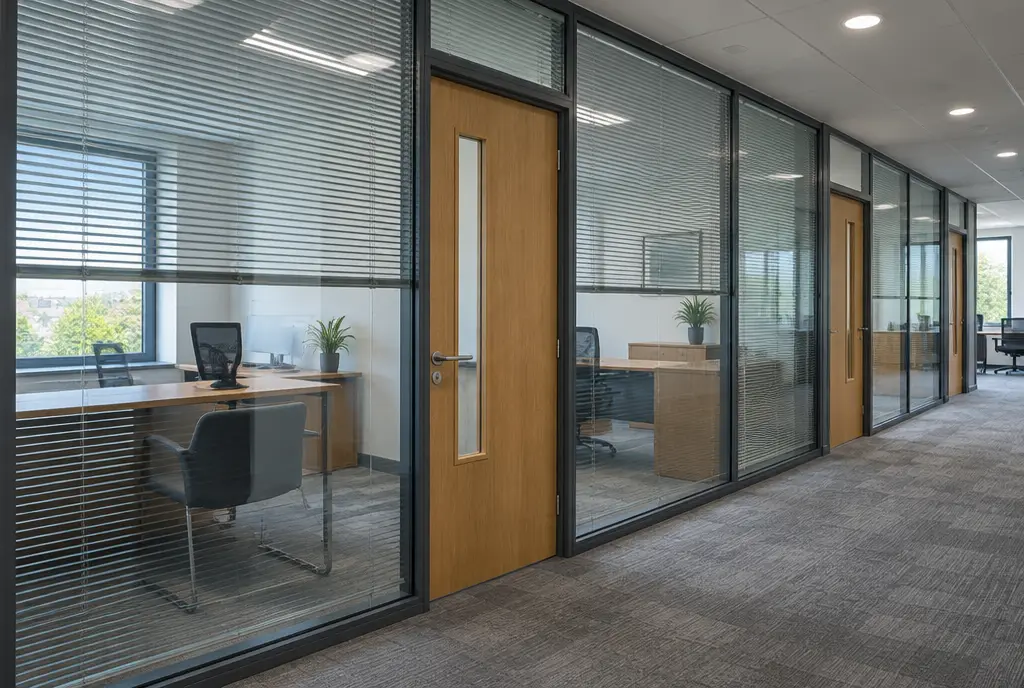
When a room has to keep conversations inside it, a single sheet of glass rarely does the job. Double glazed partitions use two panes separated by a cavity, and because each pane vibrates independently, far less sound energy makes it through. Lab ratings typically run from about Rw 42 dB to over Rw 50 dB depending on glass and cavity. That is the difference between hearing muffled voices next door and hearing almost nothing at normal speaking levels, which matters for HR rooms, finance teams, legal practices and board rooms.
The frame is deeper than a frameless system, usually 80–120mm, and it gives a crisp, architectural edge that suits corporate interiors. The cavity is also useful space: integral venetian blinds sit between the panes, protected from dust and damage, and are tilted or raised with a magnetic slider or small handle. Doors are normally framed, with drop seals and perimeter gaskets, because an ordinary door would undo much of the wall's performance. Specified carefully, a double glazed room can be bright and open without becoming a privacy problem.
Genuine speech privacy
The twin-pane construction cuts sound much more than single glazing, so confidential calls, disciplinary meetings and client discussions stay inside the room at normal speaking levels.
Blinds that stay clean
Integral blinds sit sealed in the cavity, so slats are not bent, cords do not tangle and nobody has to dust them, while still giving full privacy on demand.
A crisp framed finish
The deeper frame gives a precise, architectural edge that suits corporate and professional interiors, and powder coating lets it match your brand or ceiling grid.
Reusable system
Most double glazed systems are fully demountable, so rooms can be relocated or reconfigured later rather than stripped out and replaced at the end of a lease.
What are the specifications?
| Glass | Two panes, typically 6.4mm to 10.8mm laminated or toughened, often different thicknesses to reduce resonance |
|---|---|
| Frame depth | Approx. 80–120mm extruded aluminium, overall cavity 50–100mm |
| Acoustic performance | Approx. Rw 42–52 dB lab-tested to BS EN ISO 10140, rated to BS EN ISO 717-1 |
| Integral blinds | Venetian blinds within the cavity, manual magnetic or cord-free operation |
| Maximum height | Approx. 3m standard, taller on engineered systems |
| Finishes | Anthracite, black, white, silver anodised or any RAL powder coat |
| Doors | Framed glazed or solid doors with drop seals and acoustic perimeter gaskets |
| Safety | Glass classified to BS EN 12600; manifestation to Approved Document K |
Where are double glazed partitions used?
- Board and executive rooms
- HR and interview rooms
- Finance and legal offices
- Medical consulting rooms
- Call and video-conference rooms
- Directors' offices
What regulations and practical points apply?
A double glazed wall only performs as well as its weakest path, so the ceiling void, raised floor and junctions need attention. If the partition stops at a suspended ceiling, sound will travel over the top; a plenum barrier or full-height detail is often needed to get close to the lab figure. Expect on-site results several decibels below the published Rw. Doors should have drop seals and perimeter gaskets. Integral blinds reduce the need for film but are not a substitute for Approved Document K manifestation, which is still required. In leased offices, the landlord will want to see any work in the ceiling void.
How is it installed?
Frames are fabricated to survey dimensions, and glass is ordered in matched pairs. On site, the team fixes head and base sections, stands the vertical posts, then glazes one side, fits blinds into the cavity and glazes the other side, cleaning both inner faces before sealing. Acoustic doors are hung and adjusted last. A typical double glazed meeting room takes two to three days on site, slightly longer than single glazing because each cavity must be cleaned and checked before closing.
Free survey
We visit, measure up, check ceilings, floors and services, and talk through how the space needs to work.
Design and fixed price
You receive a layout, specification and a fixed, itemised quote. Nothing is ordered until you approve the drawings.
Manufacture and planning
Glass and components are made to the surveyed sizes while we plan access, deliveries and any out-of-hours working.
Installation and handover
The team installs, snags and cleans, then hands over with test evidence and care guidance.
Double Glazed Partitions FAQs
How much do double glazed office partitions cost?
Double glazed office partitions typically cost £420–£650 per m² supplied and installed, excluding VAT. Acoustic laminate on both panes, a wider cavity, integral blinds and acoustically sealed doors move the price towards the top of the range. We confirm a fixed figure after a free survey, once ceiling height and any plenum work are known.
How much sound do double glazed partitions block?
Double glazed partitions typically achieve around Rw 42–52 dB in lab tests, compared with roughly Rw 32–40 dB for single glazing. On site, expect several decibels less because sound also passes through ceilings, floors and junctions. In practice, normal conversation in a well-detailed double glazed room is not intelligible from outside.
Can you get blinds inside double glazed partitions?
Yes. Integral venetian blinds sit within the cavity between the two panes and are operated by a magnetic slider or small control, so there are no loose cords. Because they are sealed in, the slats stay clean and undamaged. You can specify them on some panels only, for example the wall facing the main office.
Is double glazing worth it for a meeting room?
It is worth it where conversations need to stay private, such as HR, finance, legal or board meetings. For informal team rooms and quick huddles, single glazed acoustic laminate is often enough and costs less. We usually suggest double glazing for the rooms that matter most and single glazing elsewhere.
Are double glazed partitions thicker than single glazed?
Yes. Double glazed frames are typically 80–120mm deep, compared with a slim 10–12mm glass line for frameless single glazing. The extra depth holds the cavity that gives the acoustic performance and integral blinds. It takes a little more floor space but rarely affects a room layout in practice.