
How much do timber framed glass partitions cost?
Timber species and finish, frame profile, the proportion of glass to solid panel, and matching timber doors with ironmongery are the main factors in the price. Typical lead time: 4–6 weeks. Guide prices, supply and install — fixed after a free survey.
Why choose timber framed glass partitions?
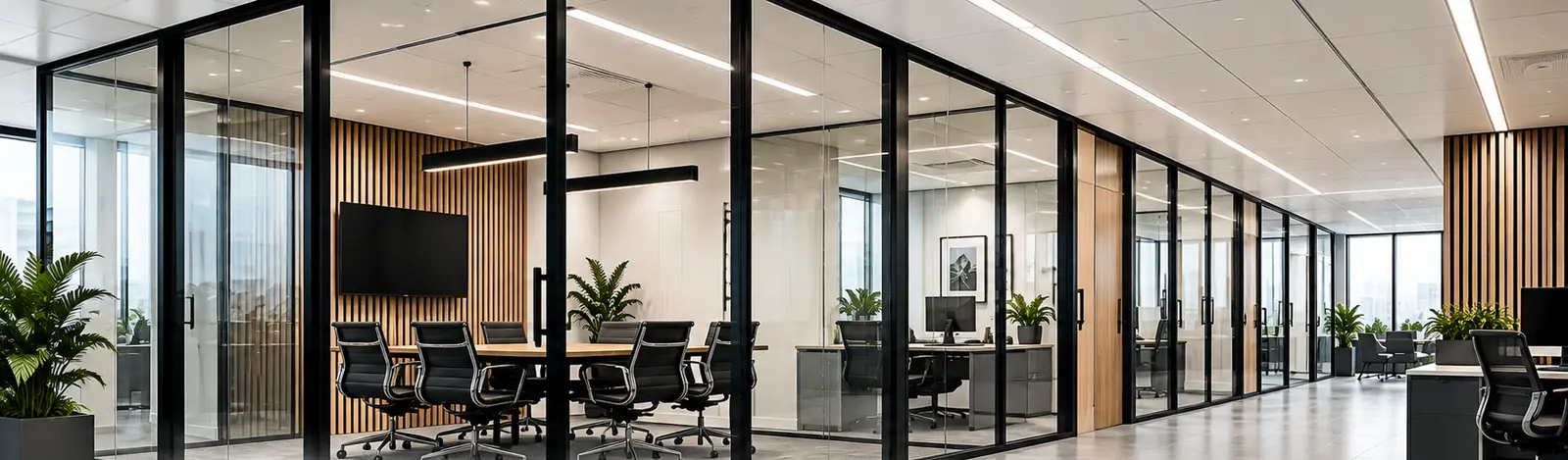
Aluminium dominates office partitioning, but it is not the only option. Timber framed glazing brings natural material into the workplace, which many organisations want as part of a calmer, more residential feel. Oak and ash are the common choices, either lacquered, oiled or stained, while painted hardwood suits schools, practices and period buildings. The timber can carry through into doors, skirtings and slatted panels, so the partition becomes part of the joinery scheme rather than a separate system.
Timber frames are deeper than slim aluminium sections and give a substantial, crafted look. They work particularly well in listed and period buildings, where aluminium can look out of place, and in hospitality-led workplaces. Wood also absorbs some vibration, which helps acoustic performance at the frame. The main trade-offs are a longer lead time, since frames are machined and finished to order, and a little more care in use: timber should be kept away from wet areas and benefits from occasional maintenance of the finish.
Warmth and natural material
Hardwood frames soften the look of glass and bring a natural texture into the office, supporting a calmer, more welcoming working environment.
Fits period buildings
Timber sits naturally in listed and character buildings, where aluminium systems can look out of place and may not be acceptable to conservation officers.
Joinery that matches
Frames, doors, skirtings and feature slats can share one timber and finish, so the partition reads as part of a single, coordinated interior scheme.
Refinishable surface
Scuffs and marks on oiled or lacquered timber can be repaired and refinished in place, rather than replacing a damaged frame section entirely.
What are the specifications?
| Timber | Solid or engineered oak, ash, sapele or painted hardwood; FSC or PEFC certified on request |
|---|---|
| Glass | 6.4mm to 10.8mm laminated or toughened single glazing; double glazing on deeper frames |
| Frame profile | Typically 45–70mm sightlines, square or moulded edges |
| Finishes | Clear lacquer, hardwax oil, stain or factory paint in any colour |
| Acoustic performance | Approx. Rw 35–40 dB single glazed laminate; up to approx. Rw 45 dB double glazed (lab) |
| Doors | Matching timber framed glazed or solid doors with butt hinges and lever handles |
| Fire option | Tested timber fire-rated glazed screens and door sets available where required |
Where are timber framed glass partitions used?
- Period and listed offices
- Professional practices
- Schools and colleges
- Hospitality-style workplaces
- Wellbeing and quiet rooms
- Boutique head offices
What regulations and practical points apply?
Listed buildings normally need listed building consent for new partitions, and timber framing with reversible fixings is often more acceptable to conservation officers than aluminium. Timber moves with humidity, so frames are conditioned and installed after wet trades and heating are working, to limit shrinkage gaps. Glazing must meet Approved Document K for safety glass and manifestation. If the partition lies on an escape route, use a tested timber fire-rated glazed screen and door set; a standard joinery frame with fire glass is not a fire-rated system. Ask about FSC or PEFC certification if your organisation reports on timber sourcing.
How is it installed?
Frames are machined and finished off site to survey sizes, which keeps dust and finishing work away from your office. On site, the team fixes the perimeter frames to floor, walls and soffit, sets intermediate posts and transoms, then glazes with timber beads and gaskets. Doors are hung, ironmongery fitted and any touch-up of the finish completed. A typical timber framed meeting room takes two to four days on site, with minimal disruption once frames are in.
Free survey
We visit, measure up, check ceilings, floors and services, and talk through how the space needs to work.
Design and fixed price
You receive a layout, specification and a fixed, itemised quote. Nothing is ordered until you approve the drawings.
Manufacture and planning
Glass and components are made to the surveyed sizes while we plan access, deliveries and any out-of-hours working.
Installation and handover
The team installs, snags and cleans, then hands over with test evidence and care guidance.
Timber Framed Glass Partitions FAQs
How much do timber framed glass partitions cost?
Timber framed glass partitions typically cost £450–£750 per m² supplied and installed, excluding VAT. Painted hardwood and simple profiles sit at the lower end, while solid oak, moulded profiles, double glazing and matching timber doors sit at the top. We confirm a fixed price after a free site survey.
Are timber glass partitions suitable for listed buildings?
Often, yes. Timber framing can look more appropriate than aluminium in period interiors, and it can be fixed in ways that are reversible. Listed building consent is still normally needed, and the conservation officer may want to see drawings and fixing details. We provide these to support your application.
Is oak or ash better for office partitions?
Both are durable hardwoods. Oak has a pronounced grain and slightly warmer tone, and it is the more traditional choice. Ash is paler, with a straighter grain, and suits lighter Scandinavian-style interiors. Both take oil or lacquer finishes, and we can supply samples before you decide.
Can timber framed partitions be fire rated?
Yes, using a tested timber fire-rated glazed screen and door set installed exactly as tested. A standard joinery frame fitted with fire-resistant glass is not a fire-rated partition. If the wall lies on an escape route or compartment line, we specify a tested system and hand over its classification evidence.
Do timber framed partitions need maintenance?
Very little in normal office use. Wipe with a damp cloth, and expect to refresh oiled finishes occasionally on busy door frames. Lacquered and painted finishes need even less attention. Scratches can be repaired in place, which is an advantage over powder-coated aluminium.