
How much do acoustic glass partitions cost?
The target Rw drives everything: higher ratings need thicker acoustic interlayers, wider cavities, sealed doors and often plenum barriers above the ceiling. Typical lead time: 3–6 weeks. Guide prices, supply and install — fixed after a free survey.
Why choose acoustic glass partitions?
Acoustic glass is less a product than an outcome. You start with how private the room needs to be, then build the specification backwards: glass type, cavity, seals, door and the detail above the ceiling. A collaboration room might only need speech to be muffled, while a counselling room or HR office needs conversations to be unintelligible at the desk outside. We ask about the room's use and the background noise in the surrounding office, because steady background sound masks speech and changes the rating you actually need.
The building matters as much as the partition. Sound takes the easiest route, so a wall rated Rw 48 dB that stops at a lightweight suspended ceiling may only perform in the mid-thirties on site. Plenum barriers, sealed perimeter junctions, acoustic door sets and attention to trunking or floor boxes that pass under the wall all close those gaps. We explain where the weak points are on your floor and price the measures needed to get close to the target, so you are not paying for glass performance the room can never reach.
Specified to a real target
We set a target sound reduction for each room based on how it is used, so you buy the performance you need rather than the most expensive glass.
Light and privacy together
Acoustic laminate and double glazing keep the room bright and visible while stopping conversations from being understood outside, which solid walls cannot offer.
Flanking dealt with
Our quotes include the ceiling, floor and junction details that limit sound bypassing the glass, which is where most acoustic partitions lose performance on site.
Safer if broken
Acoustic laminated glass holds together if it breaks, because the interlayer retains the fragments, adding containment as well as sound control.
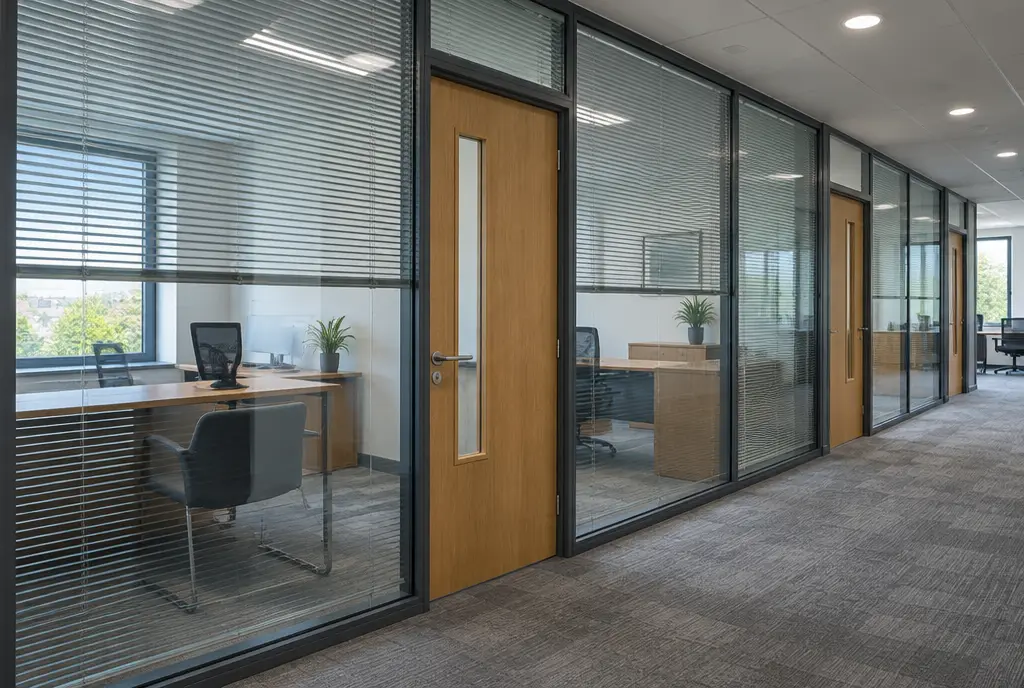
What are the specifications?
| Single glazed acoustic | 10.8mm or 12.8mm laminated with acoustic PVB interlayer, approx. Rw 38–40 dB (lab) |
|---|---|
| Double glazed acoustic | Two laminated panes with 50–100mm cavity, approx. Rw 45–52 dB (lab) |
| Test standards | Lab-tested to BS EN ISO 10140; single-number Rw rating to BS EN ISO 717-1 |
| Seals | Continuous acoustic gaskets at head, base and walls; sealed vertical joints |
| Doors | Acoustic door sets with automatic drop seals and rebated perimeter seals |
| Above-ceiling detail | Plenum barrier or full-height construction to limit flanking |
| Glass safety | Laminated to BS EN 14449; impact class to BS EN 12600 |
Where are acoustic glass partitions used?
- HR and wellbeing rooms
- Counselling and consulting rooms
- Board and client meeting rooms
- Video call and podcast rooms
- Offices beside noisy open-plan teams
What regulations and practical points apply?
Lab Rw figures are measured on the partition alone in a test facility; on-site results are typically several decibels lower because of flanking through suspended ceilings, raised floors, glazing mullions at the façade and services that penetrate the wall. If you need a guaranteed on-site figure, an acoustic consultant can set a DnT,w target and test after completion. Ventilation is a real issue: sealed rooms can overheat or feel stuffy, so check that supply and extract still serve the room, and any new grilles use acoustic attenuators. In leased buildings, plenum barriers usually need landlord approval.
How is it installed?
We start by checking what is above the ceiling and below the floor, because flanking paths decide the detail. On site, plenum barriers are installed first if needed, then the partition head, base and glass, with acoustic sealant at every junction. Acoustic doors are hung and the drop seals adjusted to close fully on the floor. A single acoustic meeting room usually takes two to four days, depending on ceiling work. Noisy above-ceiling work can be done before staff arrive.
Free survey
We visit, measure up, check ceilings, floors and services, and talk through how the space needs to work.
Design and fixed price
You receive a layout, specification and a fixed, itemised quote. Nothing is ordered until you approve the drawings.
Manufacture and planning
Glass and components are made to the surveyed sizes while we plan access, deliveries and any out-of-hours working.
Installation and handover
The team installs, snags and cleans, then hands over with test evidence and care guidance.
Acoustic Glass Partitions FAQs
How much do acoustic glass partitions cost?
Acoustic glass partitions typically cost £550–£850 per m² supplied and installed, excluding VAT. Single glazed acoustic laminate sits at the lower end; double glazed systems with sealed acoustic doors and plenum barriers sit at the top. We confirm a fixed price after a free survey of your ceilings and floors.
What Rw rating do I need for a meeting room?
For general meeting rooms, around Rw 38–42 dB is usually enough to stop normal speech being understood outside. For confidential rooms such as HR, legal or board meetings, aim for about Rw 45 dB or more, typically double glazing. The background noise in the surrounding office also matters, so we discuss the room's use at survey.
Why is on-site sound insulation lower than the lab rating?
Lab tests measure only the partition, mounted in a controlled test opening. In a real office, sound also passes over the wall through the ceiling void, under it through raised floors and around junctions. That flanking typically reduces on-site performance by several decibels, which is why our specification includes ceiling and junction details.
Is acoustic laminated glass better than toughened glass for sound?
Yes. A 12.8mm acoustic laminated panel typically achieves around Rw 38–40 dB in lab tests, compared with about Rw 32–35 dB for 10mm toughened. The sound-damping interlayer stops the glass ringing at certain frequencies. It also holds together if broken, which toughened glass does not.
Can existing glass partitions be upgraded for acoustics?
Often, yes. Common upgrades include replacing doors with acoustic door sets, adding drop seals, sealing joints, installing plenum barriers above the ceiling and swapping panels for acoustic laminate. These can improve privacy noticeably without replacing the whole wall. We assess what is achievable on a survey visit.