
Do you need landlord consent to install partitions?
Most commercial leases contain an alterations clause that controls what a tenant can change. Many permit internal non-structural alterations with the landlord's consent, often stating that consent cannot be unreasonably withheld, and some allow demountable partitions without formal consent but require notice. A few prohibit alterations entirely. Read the clause before planning, because the wording determines the process, the timescale and what happens at the end of the lease.
Even where the lease seems to allow partitions without consent, it is sensible to notify the landlord or managing agent. Partitions often affect shared building systems such as fire alarms, sprinklers and ventilation, and the landlord may hold information you need, including the fire strategy, asbestos surveys and as-built drawings of the services.
What is a licence for alterations?
A licence for alterations is a formal document in which the landlord grants consent for specified works. It usually attaches the approved drawings and specifications, sets conditions on how the work is carried out, and records whether the alterations must be removed at the end of the lease. It may require you to pay the landlord's legal and surveyor's fees. Allow several weeks for the licence to be agreed, as this is often the longest step in a partitioning programme.
What information will your landlord ask for?
Landlords and their surveyors want to be sure the works will be safe, compliant and will not damage the building or affect other tenants. A clear, complete submission avoids rounds of questions and speeds up consent. Your installer should be able to provide most of the partition information, while specialist trades provide the services details.
- Layout drawings showing partitions, doors and rooms
- System specifications and product data sheets
- Fire and acoustic test evidence where relevant
- Services alterations to lighting, ventilation, fire alarm and sprinklers
- Risk assessments and method statements
- Contractor insurance details
- Proposed working hours and access arrangements
What are dilapidations and how do partitions affect them?
Dilapidations are the tenant's obligations at the end of a lease to repair, redecorate and reinstate the premises in line with the lease. If the licence for alterations requires reinstatement, partitions must be removed and the space returned to its original condition, including making good ceilings, floors and walls and reversing services alterations. If the landlord prefers the partitions to stay for the next occupier, they may waive reinstatement, but this should be confirmed in writing.
Removal costs should be part of your budget from the start. Strip-out typically costs £20–£45 per m², excluding VAT, plus making good and reversing services alterations such as extra lighting, grilles and sprinkler heads. Demountable partitions can often be taken with you and relocated at 35–60% of the cost of new, while stud partitions become waste.
Which partition systems suit a leased office?
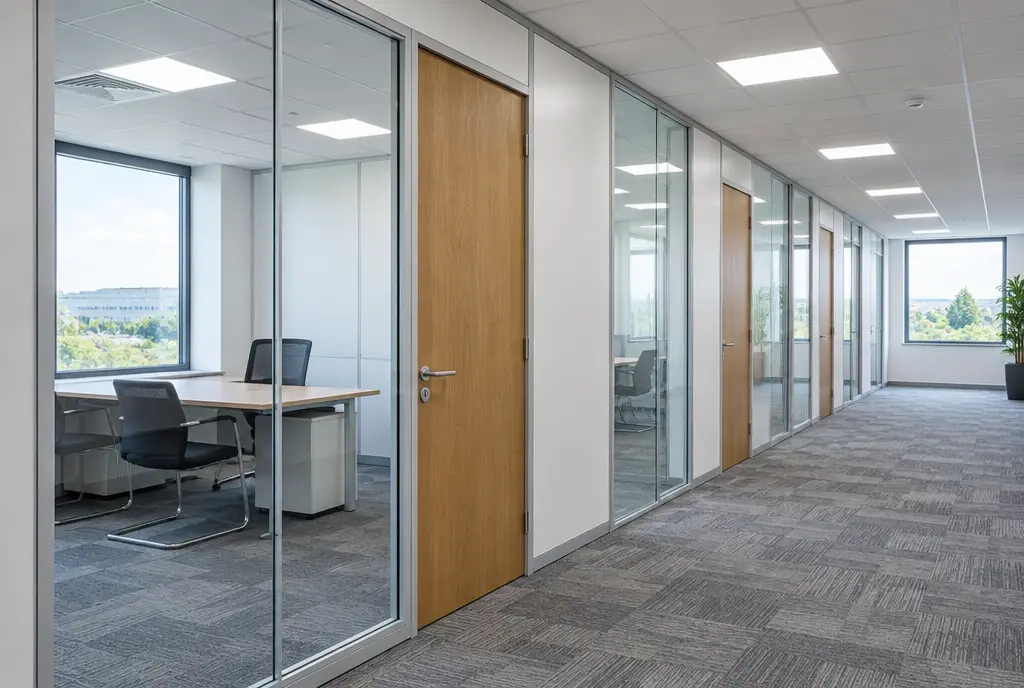
The right choice depends on lease length, break clauses and reinstatement terms. On a short lease or where a break is likely, glass and demountable systems are often better value because they can be removed cleanly, causing less damage to floors and ceilings, and reused. On a long lease with a stable layout, stud walls may be the lowest cost option even after allowing for removal. Fixing partitions to the suspended ceiling grid rather than through to the slab can also make reinstatement easier, where acoustics and fire allow.
| Lease situation | Systems often considered | Why |
|---|---|---|
| Short lease or likely break | Demountable, frameless glass | Clean removal, reuse or relocation |
| Long lease, stable layout | Stud with glass fronts | Lower cost per m², easy to adapt |
| Landlord wants partitions left | Glass or demountable | Attractive to next occupier |
| Full reinstatement required | Demountable, glass | Less making good at lease end |
How do you protect yourself at lease end?
Keep a full record of what was installed: the licence, approved drawings, specifications, test evidence and photographs before and after the work. Take a schedule of condition of the space before you start, signed by the landlord if possible, so that disputes about original condition are easier to resolve. When the lease ends, ask the landlord early whether partitions should stay or go, as removal and making good can take time to arrange. If relocating, plan the partitions into the new office before dismantling.
Frequently asked questions
Can my landlord refuse permission for partitions?
It depends on the lease. Many leases say consent for internal non-structural alterations cannot be unreasonably withheld, so a landlord would need good reason to refuse. Some leases prohibit alterations entirely. Read the alterations clause and, if unclear, take advice from a property solicitor or surveyor.
Who pays the landlord's fees for a licence for alterations?
The tenant usually pays the landlord's reasonable legal and surveyor's fees for reviewing and documenting a licence for alterations. The amount depends on the complexity of the works. Ask the managing agent for an estimate early, and include it in your project budget.
Do I have to remove partitions when my lease ends?
Only if the lease or licence for alterations requires reinstatement. Many do, but some landlords prefer partitions left in place for the next occupier and will waive removal. Get the landlord's decision in writing. Removal typically costs £20–£45 per m² plus making good, excluding VAT.
Can I take demountable partitions with me when I move?
Usually, yes, if you own them and the lease does not say otherwise. Demountable and many glass systems can be dismantled and rebuilt in a new office. Relocation typically costs 35–60% of the price of new, depending on how much can be reused in the new layout.
Guide prices are supply and install, excluding VAT, and are confirmed by a fixed quote after a free site survey. Regulatory information is general guidance; your Building Control body, landlord or fire engineer has the final say on a specific project.