
How can glass meeting rooms make an office work better?
Glass meeting rooms give enclosure for conversations while letting daylight reach the middle of the floor and keeping the space visually connected. Frameless single glazing suits informal huddle rooms, while double glazing with integral blinds suits rooms needing privacy. Placing meeting rooms in the core of the floor, away from windows, keeps window-side daylight for desks. A complete glass meeting room typically costs £6,500–£22,000, excluding VAT, depending on size and specification, confirmed after a free site survey.
Mix room sizes to match how people actually meet. Many offices find they need more small rooms for two to four people than large boardrooms, especially where hybrid meetings put one or two people on video calls. Booking data, if you have it, is a good guide to the sizes you really need, and how often rooms are booked but left empty.
What are focus booths and phone pods?
Focus booths and phone pods are small enclosed spaces for one or two people, designed for video calls, phone calls and concentrated work away from open-plan noise. They can be built from glass and stud partitions as part of the fit-out or supplied as freestanding modular pods. Built-in booths can follow the building's grid and finishes, while freestanding pods can move with you. Either way, ventilation, lighting and a power and data point are essential to make them usable.
- Single-person call booths near open-plan desks
- Two-person booths for one-to-ones and interviews
- Acoustic lining and sealed doors for privacy
- Integrated lighting, ventilation and power
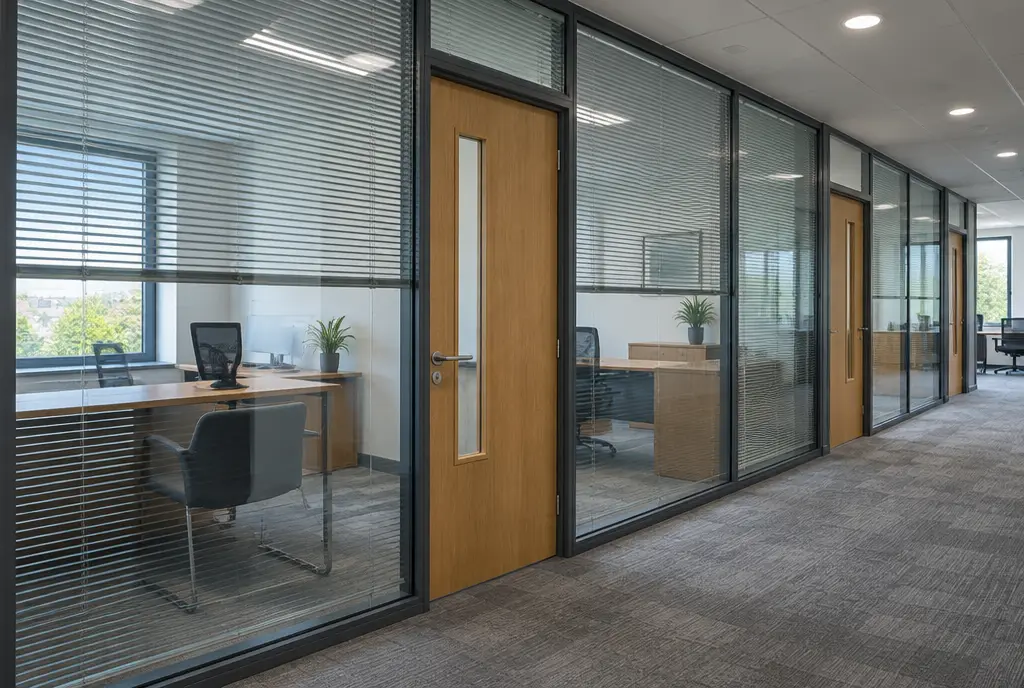
Are black framed partitions a good choice?
Black framed, Crittall-style partitions add character and definition, working well in boardrooms, receptions and feature walls. The frames make the glass more visible, which helps with safety, though manifestation is still needed in line with Approved Document K. Aluminium steel-look systems keep weight and cost manageable, with guide prices of £550–£900 per m², excluding VAT. To control budget, use framed glazing on one statement wall and simpler frameless glass elsewhere.
How can timber, felt and planting soften an office?
Natural materials and texture make offices feel more comfortable. Timber framed glazed partitions, at around £450–£750 per m², or timber slatted screens bring warmth and suit creative, hospitality and education settings. Acoustic felt panels on stud walls absorb sound, reduce echo in meeting rooms and can be cut into shapes or patterns. Planted dividers, from shelving units with planters to moss walls, bring greenery between work areas, although living plants need maintenance and suitable light.
Remember that slatted screens and planted dividers do not block sound in the way a full-height partition does. Use them to divide space visually and to absorb some noise, and use proper partitions where privacy is needed. Check, too, that freestanding screens and planters do not narrow escape routes or obstruct sprinkler coverage, smoke detection or access to fire exits.
- Timber framed glass for warmth and texture
- Slatted timber screens to divide zones
- Acoustic felt panels on walls and doors
- Planted shelving and moss panels
Can manifestation be used as branding?
Manifestation is required on most full-height glass, so it makes sense to design it rather than treat it as an afterthought. Brand colours, logos, patterns, room names and wayfinding can all be built into the bands at 850–1000mm and 1400–1600mm above floor level, provided the result remains clearly visible. Gradient films can add privacy at seated eye level while keeping the top of the glass clear. Bands cost around £15–£35 per linear metre and full privacy film £45–£85 per m², excluding VAT.
How should you choose the right ideas for your office?
Start with how people work, not with a style. Talk to teams about what is missing, such as quiet space, call space or meeting rooms, and look at how existing rooms are used. Then decide where you need light, privacy, flexibility and character. Match each space to a system: glass where light matters, acoustic partitions where privacy matters, demountable where change is likely, and feature finishes where they add to the brand. A survey turns those ideas into a practical layout and budget.
| Idea | Suits | Guide cost |
|---|---|---|
| Frameless glass meeting room | Light and openness | £6,500–£22,000 per room |
| Black framed feature wall | Character, boardrooms | £550–£900 per m² |
| Timber framed glazing | Warmth, creative spaces | £450–£750 per m² |
| Acoustic stud with felt finish | Quiet rooms, echo control | From £80–£130 per m² plus finish |
| Branded manifestation | Brand identity and safety | £15–£35 per linear metre |
Frequently asked questions
What is a low-cost way to divide an office?
Metal stud partitions are usually the lowest cost per m², at around £55–£90 per m², excluding VAT. Freestanding screens and furniture-based dividers cost less again but give little acoustic privacy. Glass partitions cost more but bring daylight through the floor. Prices are guides confirmed after a free site survey.
How do you add privacy to glass partitions?
Options include manifestation bands, full or gradient privacy film, integral blinds in double glazed partitions and switchable smart glass. Film is the lowest cost, at around £45–£85 per m², while switchable glass gives instant privacy at a higher cost. Choose based on how often each room needs privacy.
Do slatted timber screens reduce noise?
Only slightly. Open slatted screens divide space visually and can absorb a little sound, especially with acoustic backing, but they do not block conversation. For real privacy, use a full-height partition with an appropriate Rw rating, sealed door and treated ceiling void.
Are phone booths better built-in or freestanding?
Built-in booths integrate with the building's finishes and services, while freestanding pods can be moved and taken with you. Built-in suits long leases and stable layouts, while freestanding suits short leases or growing teams. Both need ventilation, lighting and power to be comfortable.
Guide prices are supply and install, excluding VAT, and are confirmed by a fixed quote after a free site survey. Regulatory information is general guidance; your Building Control body, landlord or fire engineer has the final say on a specific project.