
What is the difference between single and double glazed partitions?
A single glazed partition uses one layer of safety glass, typically 10mm or 12mm toughened glass or a laminated glass of similar thickness, held in a slim head and floor channel. Adjacent panes usually meet with a clear dry-joint strip or a silicone butt-joint, giving an almost frameless look. A double glazed partition uses two panes held apart in an aluminium frame, creating a cavity that improves acoustic performance and can house integral blinds operated from one side.
Both use toughened or laminated safety glass made to BS EN 12150 or BS EN 14449 and impact classified to BS EN 12600. Neither is a structural wall: both rely on the floor, the ceiling or soffit and adjoining walls for fixing, and both need manifestation where people could walk into the glass. The choice comes down to how much sound separation each room needs, how you want to control privacy and what the budget allows.
Which is better for sound insulation?
Double glazing wins on acoustics. Indicative laboratory figures, expressed as Rw to BS EN ISO 717-1, are around 32–35 dB for 10mm toughened single glazing and 38–40 dB for 12.8mm acoustic laminated single glazing. Double glazed systems typically achieve 42–52 dB depending on glass thicknesses, cavity width and seals. In practical terms, normal conversation is usually intelligible through a basic single glazed partition but is reduced to a murmur or less through a well installed double glazed system.
Site performance is normally several decibels below the laboratory figure, because sound travels around the partition through the ceiling void, the floor, door gaps and adjoining window mullions. A double glazed partition only delivers its potential if the door is sealed and the ceiling void above is treated. For confidential meeting rooms, HR spaces and boardrooms, plan the acoustic detail around the whole room rather than relying on the glass alone.
How much more do double glazed partitions cost?
Guide prices for 2026 are £280–£420 per m² for frameless single glazed partitions and £420–£650 per m² for double glazed, supply and install, excluding VAT. At a 2.7m ceiling height that is roughly £756–£1,134 per linear metre against £1,134–£1,755. Integral blinds add around £150–£250 per m² of glazing. Doors differ too: a double glazed run normally takes a framed door with seals, while single glazing pairs naturally with a frameless glass door. All prices are guides confirmed after a free site survey.
Can you fit blinds to single and double glazed partitions?
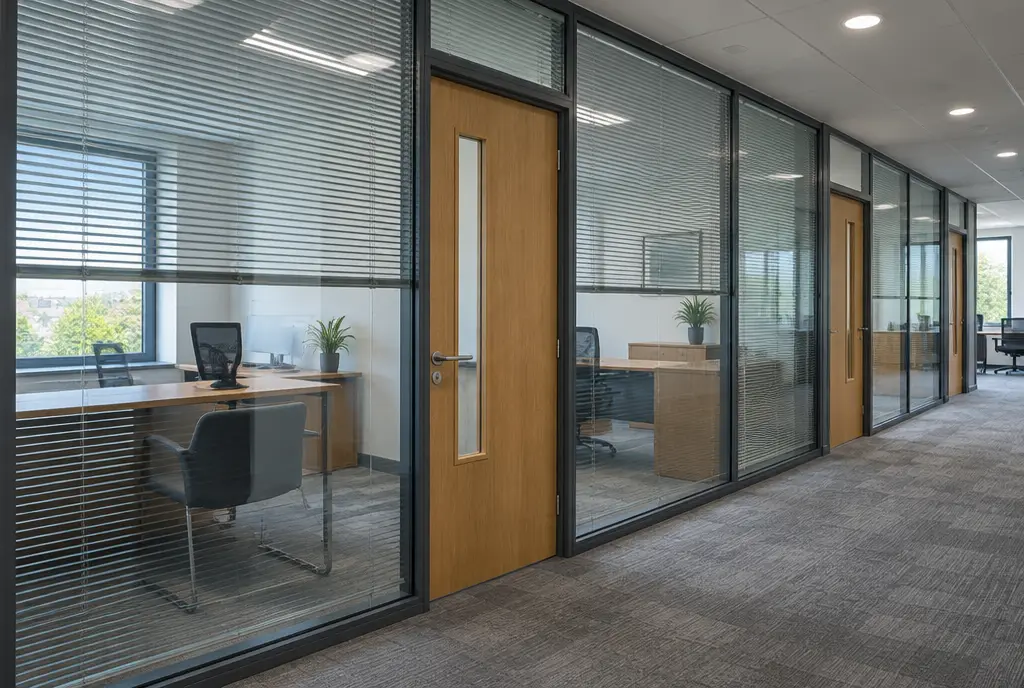
Integral blinds are only possible with double glazing, because the blind sits in the sealed cavity between the two panes. It stays dust-free, cannot be damaged by knocks and is operated by a magnetic slider, cord or motor on one face. This makes double glazing a common choice for rooms that switch between open and private use, such as meeting rooms, managers' offices and interview rooms.
Single glazed partitions rely on other privacy methods. Decorative or frosted film gives permanent privacy at £45–£85 per m², manifestation bands give partial screening at £15–£35 per linear metre, and switchable smart glass gives instant privacy at a much higher cost. Surface-mounted roller or venetian blinds can be fitted on the room side, but they collect dust and are more exposed to damage.
How do single and double glazed partitions compare side by side?
The table below summarises the practical differences between the two approaches. Acoustic figures are indicative laboratory values, prices are 2026 guides for supply and install excluding VAT, and lead times run from design sign-off. The exact performance depends on the specific system, glass make-up, door choice and site conditions, so treat the comparison as a starting point for the conversation at survey rather than as a specification.
| Factor | Single glazed | Double glazed |
|---|---|---|
| Typical glass | 10–12mm toughened or 12.8mm acoustic laminated | Two panes, for example 6mm toughened and 6.4mm laminated, in a frame |
| Indicative lab Rw | 32–35 dB toughened, 38–40 dB acoustic laminated | 42–52 dB |
| Guide price per m² | £280–£420 | £420–£650 |
| Integral blinds | Not possible | Yes, around £150–£250 per m² extra |
| Appearance | Minimal, near frameless | Visible frame, slim to medium sightlines |
| Typical door | Frameless glass pivot or hinged | Framed glazed door with seals |
| Lead time to start | 2–4 weeks | 3–5 weeks |
| Suits | Open, light-filled spaces with modest privacy needs | Meeting rooms, offices and confidential spaces |
Which should you choose for your office?
Choose single glazing where the aim is to bring daylight into the floor and divide space visually while keeping costs controlled, for example team areas, corridors, breakout spaces and rooms used mainly for focused work rather than confidential discussion. Choose double glazing where conversations must stay private, where you want blinds without exposed fittings, or where the room sits next to a busy open-plan area. Many projects mix the two, using double glazing for meeting rooms and single glazing elsewhere.
If budget is tight but a room needs better privacy, a single glazed acoustic laminate with a sealed door and a ceiling void barrier can close part of the gap. Discuss how each room will actually be used at the survey, because the right answer is often decided room by room rather than by choosing one system for the whole floor.
Frequently asked questions
Is double glazing worth it for a meeting room?
Usually, yes, if the meeting room will host confidential discussions or sits beside a busy open-plan area. Double glazing typically achieves 42–52 dB Rw in the laboratory against 32–35 dB for basic single glazing. The benefit depends on a sealed door and a treated ceiling void, so specify the whole room, not just the glass.
Can single glazed partitions be made more soundproof?
Yes, to a point. Specifying 12.8mm acoustic laminated glass instead of 10mm toughened raises the indicative laboratory rating from around 32–35 dB to 38–40 dB Rw. Adding door seals and a ceiling void barrier helps the room perform closer to that figure on site. For high privacy, double glazing remains the stronger option.
Do double glazed partitions look bulkier?
They have a visible frame, wider than the slim channel of a frameless single glazed system, but current double glazed systems use slim profiles and flush glazing that look neat and contemporary. Frames can be powder coated in a range of colours, including black for a framed industrial look.
Which is quicker to install?
Frameless single glazing usually has the shorter lead time, typically 2–4 weeks from design sign-off to start on site, against 3–5 weeks for double glazed systems. Time on site is similar for comparable areas, although double glazed systems with integral blinds need a little more care during fitting and adjustment.
Guide prices are supply and install, excluding VAT, and are confirmed by a fixed quote after a free site survey. Regulatory information is general guidance; your Building Control body, landlord or fire engineer has the final say on a specific project.